It happened here, within, something changed to enable me to see in a different way, sense things I could not before, shifted the ground on which I stood, opened new avenues into the world. What was it? A look on Lynn’s face, that knowing smile, that relentless gaze—that released me from boundaries, walls, limits that had grown without my realizing it—that released in me the force of love that knocked them aside…
Archive for April, 2020
Each member of the SF Giants can request a song while at bat…write lyrics for yours
April 29, 2020Take me out to the ball game
Set me loose on the turf
Give me a distant point to aim
Do not dissolve into mirth.
Why is it always the same,
Can it be my fragile nerf?
Surely I am to blame
When I miss every ball with a curf!
Write about something you know absolutely nothing about. Make all of it up.
April 25, 2020The background for this discovery was in the sediment deposited by a jellyfish. It seems that it gave a special intelligence to any creature that rubbed against it. Now, the underlying reason it turns out has to do with the similarity of the cells in that sediment to certain cells in the brain of any creature. After contact with it these creatures began to communicate, forming a little community that could experience fear, happiness, and courage. Indeed after a while they would violate the habitual behavior of their species and were able to emulate others’ behavior. They established a creatures’ actors Guild and began giving performances…
topic idea from 642 things to write about
Journey
April 25, 2020The journey into unknown territory
Begins with a hope
That it will lead somewhere
You might wish to go.
That journey may have nothing to do
With where you might have cared to go
Or with how you might have preferred to get there
Even a journey into known territory
With a clear aim
May not lead where you thought it would
But instead to places you could not possibly have imagined
And journey, regardless of its supposed destination,
May shape and reshape
Its original purposes.
Anxiety Coping Techniques
April 25, 2020Apple Technique
AnxietyUK suggests practising the “APPLE” technique to deal with anxiety and worries.
Acknowledge: Notice and acknowledge the uncertainty as it comes to mind.
Pause: Don’t react as you normally do. Don’t react at all. Pause and breathe.
Pull back: Tell yourself this is just the worry talking, and this apparent need for certainty is not helpful and not necessary. It is only a thought or feeling. Don’t believe everything you think. Thoughts are not statements or facts.
Let go: Let go of the thought or feeling. It will pass. You don’t have to respond to them. You might imagine them floating away in a bubble or cloud.
Explore: Explore the present moment, because right now, in this moment, all is well. Notice your breathing and the sensations of your breathing. Notice the ground beneath you. Look around and notice what you see, what you hear, what you can touch, what you can smell. Right now. Then shift your focus of attention to something else – on what you need to do, on what you were doing before you noticed the worry, or do something else – mindfully with your full attention.
Shriek Technique
I, in reaction to the “Apple” technique, suggest “Shriek” as an alternative means to cope with anxiety and stress:
Shout: make it loud and unpredictable in timing
Hysterically: better because you blind yourself to what you are doing but others will surely notice
Rant: this is an art form, but it can be perfected with frequent use and can be tested by the degree to which others avoid you or take protective action
Indiscriminately: very important, part of the art.
Exaggerate: an absolute necessity to move what you have said out of the ordinary reality of others
Katastrophically: couldn’t find the right “k” word, but what the hell. The point is to cause disruption in the world as well as the language.
Muddleheadedness-?
April 23, 2020What started as an effort to capture a particular state of mind labeled “muddleheadedness” has turned toward trying to understand the state of mind I find myself in these days. I suppose one can be muddleheaded as a result of overstimulation, or an onslaught of competing stimuli, or a plethora of options for something that was thought to be straightforward; but it is not this kind of state that I am attempting to explicate. Instead it is my state of mind that results from the particular situation I find myself in. Muddleheadedness is not the right comprehensive label for that condition, although there are moments when it does seem to describe the state of mind quite well. My effort, though, is to get at deeper levels of thought and feeling that accompany the situation I find myself in.
First it will be helpful to describe some of the aspects of this “situation.” I have been “sheltered down“ in my house here in Cambridge for more than one month rarely venturing off the property. The city and the state have imposed restrictions on what to do in public places like keeping a distance from others and wearing a face mask. Many stores are shut, and others have devised ways of serving the public by catering to them at the curb after orders have been called in. I could go on but the “public realm“ that we have customarily looked to as part of our life space has been dramatically restricted and transformed. Additional restrictions I am a coping with are a slow recovery from a broken shoulder and the subsequent operation, a “total reverse replacement” with large pieces of metal. So far this has restricted my mobility outside the limits of my property to those times that someone can accompany me. Thus, not only are there severe limits imposed by public authority on behavior in public spaces but also those imposed by my recent injury and operation. The results of these limits are to force uncharted behaviors and patterns of life. But, more importantly, they force changes in attitude, outlook, mood, and the capacity and desire to undertake normal as well as extraordinary projects, real and imagined.
It’s tempting and perhaps too easy to expand on the aspects of life space and life encounters that these restrictions affect: not seeing friends in person, not being able to attend public events, concerts, let alone private gatherings; changes in the information we receive, both its content and its intent. The situation we find ourselves in, sheltered down as we are, is one in which the outside realm has changed, becoming far less accessible to us as part of our life space. Also, this realm, created by the poisonous disease running rampant, has been partially filled by ignorant and biased individuals who have managed to acquire positions of power, some at the highest levels of our government, and who have room to continue their damaging rampages alongside the pandemic, largely unchecked; and they have found voice through the media. As a result one feels disempowered, less complete, more isolated. One senses a decline of democracy and democratic principles, and victimized by those in government and many organizations who seem intent upon further acquisition of power and wealth without the checks and balances that we have previously counted upon.
Vulnerability
April 16, 2020What moved this idea to a high level of intensity was my reading about the death of Michael Sorkin who was 71. Mobile, playful but serious thinker in architecture who contracted the COVID-l 9 and died a few days later. I am certainly among the most vulnerable in the population, 86, with prostate cancer and receiving chemo treatments, and with COVID-19 about to enter its most explosive episode of two or many more weeks. It brought me up short that he would succumb and so quickly. What is it to be vulnerable? To be open to attack without adequate means of defense; to be open to attack because of inadequate surveillance; to be open to attack because of weakness and the inability to defend oneself; to be resigned to the likelihood of attack and subsequent defeat; to be inclined toward self destruction.
It seems that intentionality has much to do with certain kinds of vulnerability. Misjudgment of the conditions one is in and of their nature or strength, but especially deliberate misjudgment of the conditions. The feeling of vulnerability derives from a sense of weakness with respect to some threat more powerful than you think you are. And it typically arises when one is on a path along which one believes the threat will become an actual attack, or realize itself in ways one can at least partly imagine. An example of the latter might be a rope bridge across a deep valley that shows torn or weak elements, or simply the path of getting older! Vulnerability can also be a posture that belies underlying strength and skill, as for example in wrestling where a feint can be turned against an opponent who would underestimate the strength or deftness of the move. Vulnerability can be analyzed as for example in football where uniforms are specifically deigned to address certain vulnerabilities and where certain kinds of contact are prohibited. But this is a game and the parameters and rules that govern its play have evolved over time to deal with empirically discovered vulnerabilities, and unlike nature these parameters can he adjusted to lessen the probability of damage. And both of these conditions imply some control over the external parameters. Not so with nature, or at least not so before the vaccine is developed. Strategies must be built out of a knowledge of the virus and its behavior and later of its elements and structure. Thus social distance takes account of the virus’ love of the proximity of people and how it spreads itself. Later, once the destructive behaviors of the virus itself are better understood and ways of parrying those behaviors are developed, like the football uniform and the rules governing opponents’ behavior, the damage can be minimized or eliminated. Here, the metaphor falls short, if ever it did not, because at this point the very game the virus plays would be eliminated rather than letting it play on with reduced damage.
Two Studios
April 14, 2020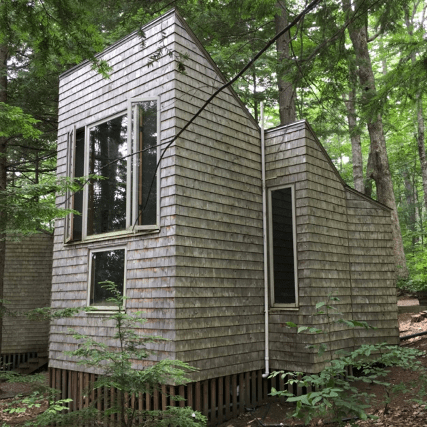
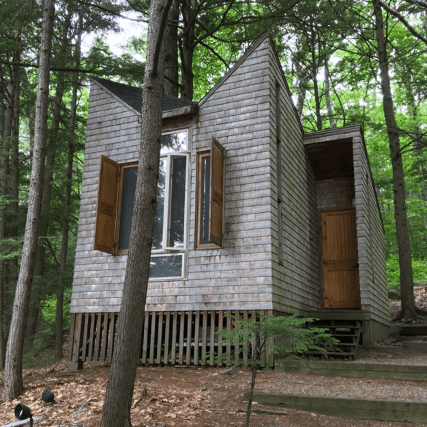
On the path down the hill from our parking lot to our camp on the lake’s edge seemed the best place for Lynn’s, my wife’s, studio and my own. Hers would be for the creation of jewelry and crafted art pieces, mine for writing and work with the piano. The two are on opposite sides of the path, angling away in opposite directions from it, and suggesting alternative and contrasting domains.
Lynn’s you enter through a door looking toward the lake. Once inside, on axis is a long vertical window permitting only a hint of the lake through the trees with which it is in dialog. But your movement takes you left under the rising roof to a new perpendicular relationship with a differently angled lakeside façade. Through large windows it reveals the sky and floods the working countertops with light. Turning back still further to the left there is an alcove not aligned with the light giving windows but instead with the entrance door to the studio. It offers a stable place of repose with its own smaller source of light toward the lake and sky. The alcove with its couch and shelf above does not permit standing. From there there is only the rising ceiling and a smaller window to the left to gaze at the sky. Re-entering the main work area and sitting to go to work, the lower window in the lakeside façade offers a view of the downward sloping floor of the forest and its details as it makes it way toward the lake. When you leave the studio the light washes the walls and the underside of the roof toward the relatively darker zone of the entrance through which you transition back out into the filtered light of the woods.
My studio you enter on the way up the path, away from the house, a slight move to the left to up the steps to enter. The roof and walls that reached out to invite you now constrict you from above and from the sides. You are in a darker place, an alcove with windows to the left, and where the only movement possible is to the left, returning toward the place from which you came. That wall of the alcove is not aligned with the path of entrance. Instead it expands out toward the lake and the roof above rises with it. By now you have turned 180° from entering through the door to entering the space of the studio. While the walls and ceiling open to the lake, part of the ceiling drops down in a gesture of closure and the windows emphasize verticality. On the side walls vertical slots of windows create a slight wash of light on the front wall thus detaching it somewhat from its enclosing role. The four surfaces defining the space are not parallel, all opening in the direction of the lake. Constraining the psychological movement in that direction are how the light is made, where the windows are placed, and how they are shaped. The result is to create a place to which you have arrived, in gentle tension with the continuity of movement and light.
Pegasus 2
April 10, 2020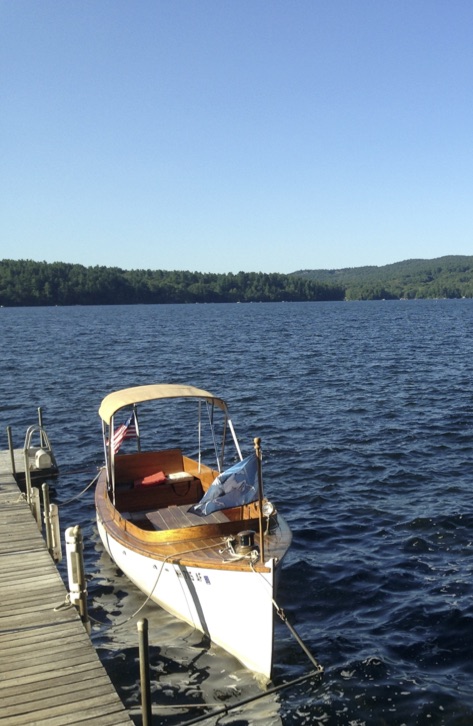
Dusk.
In silence.
A gentle push away from the dock.
Seeming to drift backward,
But now with direction.
Then forward,
Pushing my body gently back.
Underway
The journey has begun,
As has my awareness of what its building blocks may be.
Eyes shift in anticipation.
Speed and noise increase,
As does brightness in the east above the distant mountains.
The waves lap against the hull,
The air against my face.
The immense volume of the sky opens.
Moving toward and moving away,
Scenes change left and right,
The places I’m in change,
Sometimes rapidly as land and islands move closer, then farther,
And sometimes slowly with more expansive and stable views.
The highlights in the sky move west.
The sun disappears.
Twilight envelopes all.
I slow Pegasus to stillness and silence.
Time to return,
To follow, as it happens, the light in the sky.
Pegasus can’t keep up with the shift of light.
It spreads along the western horizon,
And, after a brief celebration in brightness,
Becomes a half glow that no longer illuminates the landscape.
The lake becomes dark
Landmarks lose their familiarity,
Orientation becomes more difficult,
Light buoys are friendly companions
If only I could remember exactly which each was.
And the shape of the land against the sky,
An imprecise guide.
A weak flashlight, scarcely better than none.
Yet somehow I find myself near Mooney Point.
Uncertainties fade into secure known places.
Pegasus is now at her dock.
Pegasus 1
April 10, 2020
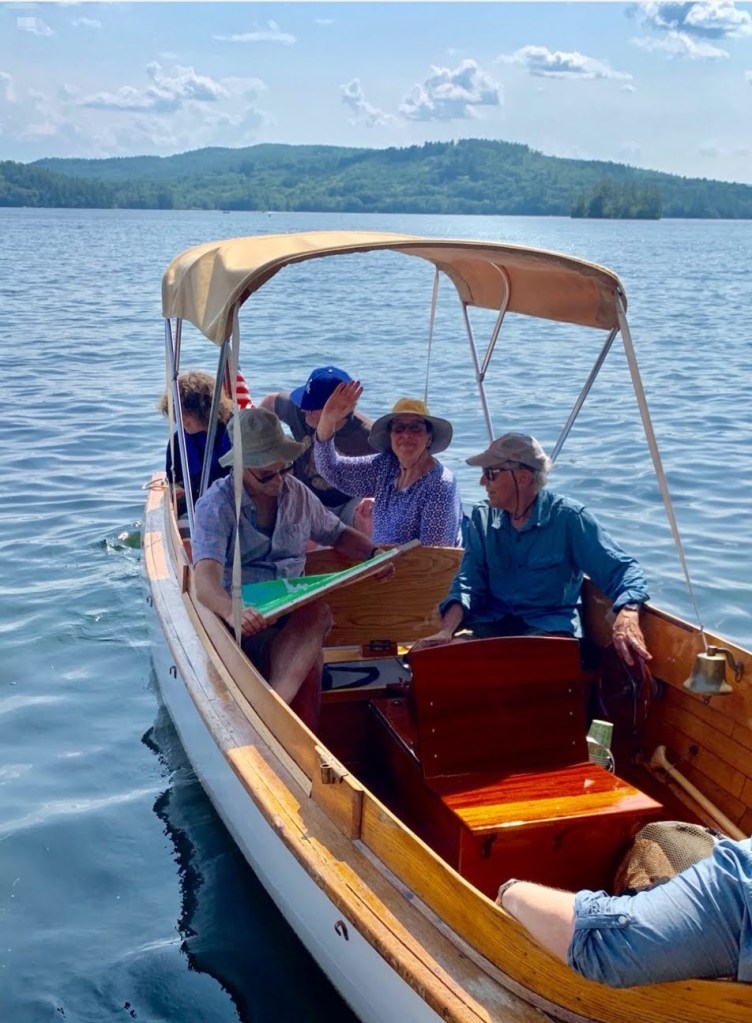
Pegasus is on the lake about the same time as her namesake, the constellation, is in the sky. She is a twenty six foot launch, now with an electric motor. At slow speeds she is silent; faster, still quiet. The lake reveals itself through the lapping of water against the hull, through the breeze with its distinctive scents and feel against your face, through the sounds of wind in nearby trees and from more distant waves, and from the occasional disjointed chorus of loons, gulls and other birds. Slowing, one can study a loon cleaning its feathers and then disappearing in a sudden dive, the cormorant hanging its wings to dry, the eagle menacing with too low a flight. The sky reveals the silent dance of the clouds in a rhythm and speed different from yours. Other boats intrude but at dusk there are few, and, at a distance, they, too, are quiet. With the lake so present, conversation in the boat can be sporadic—a warm episode of exchange followed by silent reflection and warm exchange with the lake.
 Aaltoe's Blog